
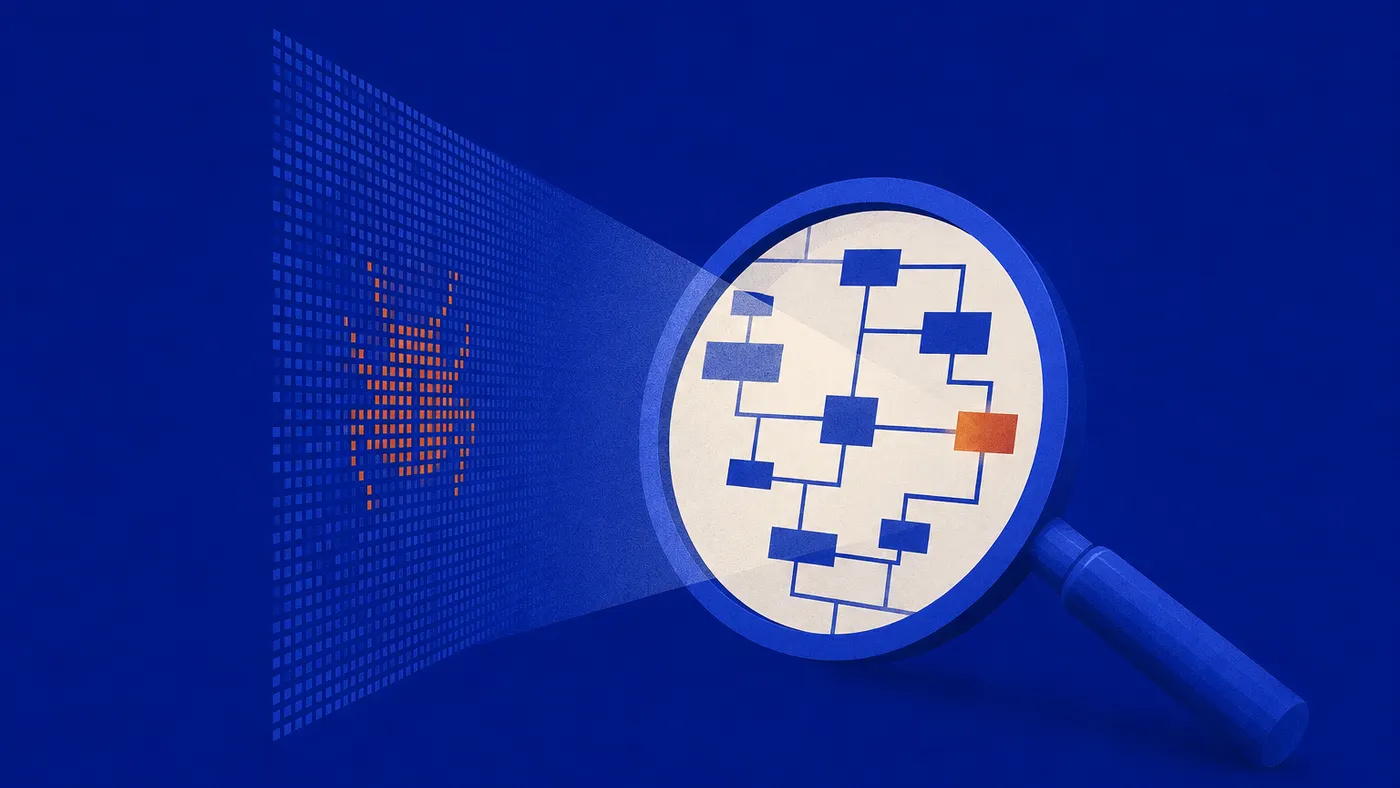
On 29 July 2026, researchers at Fudan University posted a preprint describing MalGuard, a malware detection system that maps software as graphs of interacting code blocks instead of scanning raw bytes S¹. The method targets threats that reshuffle their bytes to evade conventional detectors, a class of attack that has quietly undermined the most widely used defence in the field. What the paper actually proposes, and what it leaves unproven, tells you where malware detection is heading.
My read: This is the second malware detection paper I've seen this month reaching for structural analysis over byte-scanning. Another recent preprint, HilEnT, converts malware into images for AI classification, and the impulse is the same: model what code does, not what it looks like. MalGuard's specific contribution, grouping basic blocks into "operational roles," is promising because it targets the gap between seeing code structure and understanding code behaviour. But this is a non-peer-reviewed preprint with no quantitative results in the abstract, and the authors' framing of existing methods' weaknesses is their own argument, not industry consensus. I'd watch for whether the code and datasets go public.
Why bytes fail and graphs don't
Most malware detection in the wild uses byte-based machine learning: the system reads the raw bytes of a file and looks for patterns that match known malware S¹. The problem is that attackers can manipulate those bytes without changing what the program actually does when it runs S¹. Graph-based methods take a different approach. They represent software as a program graph, a map of how the code executes, which captures behaviour rather than appearance S¹. Reshuffling bytes doesn't change the graph's structure, so these methods are harder to fool S¹.
The gap MalGuard tries to fill
Existing graph-based detectors have two weaknesses, according to the paper's authors S¹. First, they don't identify cohesive groups of basic blocks, the smallest units of executable code, that work together to perform a specific function S¹. Second, they don't learn representations of the program graph that are expressive enough to distinguish malicious behaviour from benign code that looks structurally similar S¹.
MalGuard addresses both. Its first innovation, operational role identification, clusters basic blocks into groups that jointly realise meaningful program behaviours S¹. Think of it as identifying the jobs different parts of the code are doing, rather than treating every block as an isolated node. Its second innovation, program graph representation learning, models the interactions between these operational roles, preserves sparse malicious signals (the faint traces of malicious behaviour that are easy to lose in a large graph), and captures the hierarchical structure of the program S¹.
What to do about it
For a security team at a mid-sized logistics company, the practical question is whether to invest in graph-based detection at all. The honest answer: not yet on the basis of this paper. MalGuard is a preprint. It hasn't been peer-reviewed, and it reports no specific accuracy numbers S¹. What it does signal is a direction. If your endpoint detection vendor mentions graph-based or behavioural analysis in their roadmap, this is the kind of research shaping that roadmap. The operational role concept, grouping code blocks by function, could eventually improve false-positive rates because it models what code does rather than what it looks like. For now, the concrete step is to ask your detection vendor whether their product analyses execution graphs or relies on byte signatures, and how they handle packed or obfuscated malware. The answer tells you how exposed you are to the evasion attacks this paper targets.
What we don't know yet
The preprint provides no detection rates, no benchmark names, no accuracy percentages, and no cost-savings figures S¹. The claim that MalGuard "improves detection performance" and "reduces the expected cost of undetected malware" is an unverified author assertion S¹. The paper has not been peer-reviewed S¹. There is no evidence the method has been tested outside experimental conditions or deployed in any real organisation S¹. The arXiv categorisation includes q-fin.GN (quantitative finance), which is unusual for cybersecurity research and may reflect the authors' affiliation with Fudan's School of Management rather than a computer science department P². A separate, unrelated paper also named MalGuard was posted in June 2025 about detecting malicious packages in the Python Package Index P⁵, so the name collision is worth noting if you're searching for this work. The next signal: a v2 revision on arXiv or a peer-reviewed publication, which for preprints typically appears within three to six months. We'll check it for quantitative results and public code release.
Subscribe if you want the next research paper decoded this plainly.
Sources: S1 — Guarding Organizations Against Malware Risk: A Novel Graph-Based Malwa · P2 — 1 Introduction · P3 — dtrizna/nebula · P4 — doanhieung/graph-malware-classification · P5 — MalGuard: Towards Real-Time, Accurate, and Actionable Detection of Mal
More from Not A Tech Guy
- OpenAI model proves ten math results with Lean certificates
- SCAIR steers AI agents with enterprise schemas, no retraining
- SeT-Diff: first foundation model for supercomputer telemetry
Generated from an audited evidence pack with primary-source research. Social-media items are discussion signals, not verified facts. Nothing here is financial, legal or medical advice.


