

On 28 July 2026, a preprint named SeT-Diff was posted to arXiv by the University of Bologna and CINECA, asserting it is the first foundation model for supercomputer telemetry S¹P². The paper states it achieves a Mean Absolute Error of 0.0470 for reconstruction and 0.033 for thermal inference using a single pre-trained model S¹. The approach works by conditioning on the type of measurement a sensor captures instead of its physical location, prompting a critical question for data centre operators: what is the impact when the sensors are replaced?
My read: I have not seen another HPC telemetry model that approaches sensor identity as a semantic issue instead of a positional one. Using text descriptions of sensors to condition a diffusion model is a smart approach, and if the zero-shot permutation stability claim survives peer review, it solves a genuine data centre monitoring pain point. However, the "first foundation model" label seems premature, as the abstract provides no baselines or dataset identifiers. Without comparisons, the MAE values lack context. Independent reproduction and peer review are necessary before considering this production-ready.
Why HPC telemetry models break today
Today's machine learning models for HPC telemetry depend on a fixed set of anonymous, stationary sensor variables, with each model designed for one specific task S¹. Changing a sensor or switching tasks renders the model useless S¹. This is a known challenge in time-series ML. SeT-Diff attempts to solve a more difficult variant of this problem: when the data source itself changes.
How SeT-Diff reads sensors
SeT-Diff operates as a diffusion model, utilizing the same generative framework found in image synthesis tools. The fundamental concept is that it conditions the generative process on the semantic description of each sensor, thereby separating system dynamics from the dataset's structure S¹. In simpler terms, the model comprehends the concept of "CPU temperature" rather than merely identifying column 47 in a spreadsheet. When sensors are rearranged, the model preserves its accuracy with negligible decline, a characteristic the authors label as zero-shot permutation stability S¹.
A single pre-trained SeT-Diff model is capable of executing three tasks: data imputation (filling in missing values), forecasting (predicting future readings), and virtual sensing (estimating a reading without a physical sensor) S¹. The authors describe this as a data-driven digital twin for HPC systems S¹.
What the numbers show
The authors present two self-reported metrics derived from a real-world supercomputer dataset S¹:
- Mean Absolute Error of 0.0470 on reconstruction tasks
- Mean Absolute Error of 0.033 on thermal inference
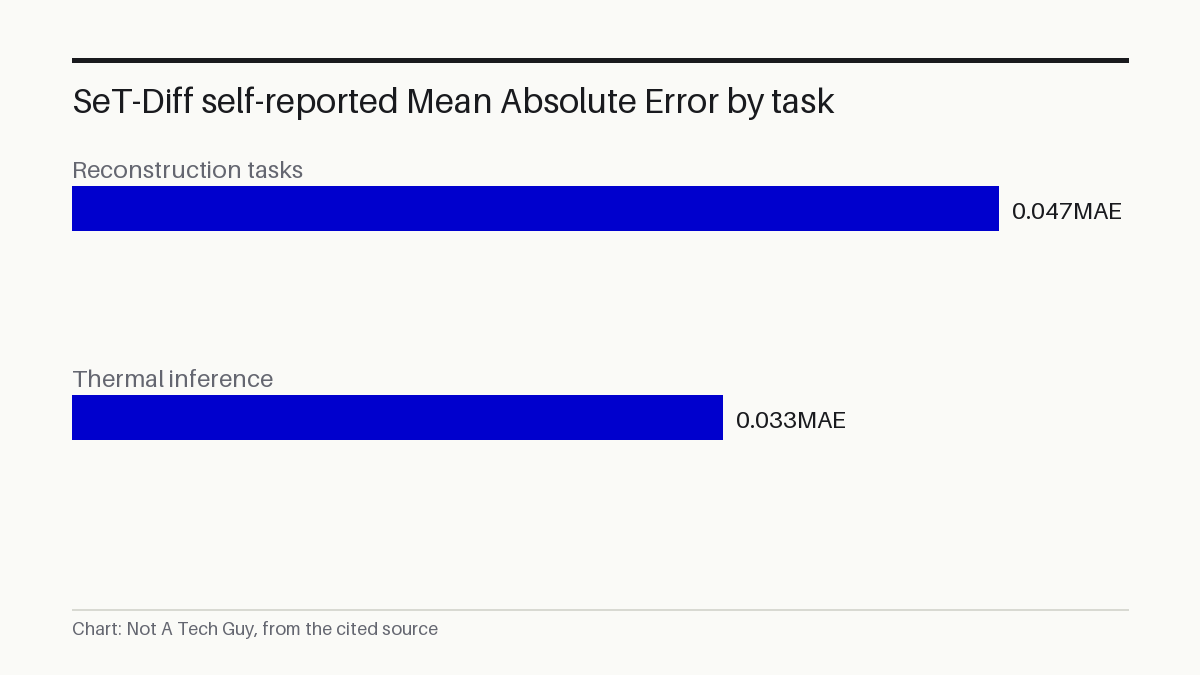
MAE indicates the average deviation between predicted and actual values, where lower scores are superior. Both statistics originate from the authors without any specified baselines for comparative purposes S¹.
What to do about it
For a site reliability engineer at a mid-sized HPC facility, the practical appeal is clear. Today, if a temperature sensor on node 14 fails, the telemetry pipeline either drops that data point or requires a model retrain. SeT-Diff's virtual sensing capability, if it holds up, could estimate the missing reading from surrounding sensors without retraining. Fewer blind spots, less manual intervention.
For teams building observability tooling, the semantic conditioning approach is worth watching. Tools like last9's gpu-telemetry agent already tie hardware metrics to specific Kubernetes pods or Slurm jobs P⁵. A model that understands sensor semantics could sit on top of that stack, handling gaps and forecasts without bespoke pipelines for each sensor layout.
One thing to check this week: if you run an HPC or GPU cluster, count how many of your monitoring models would break if you swapped one GPU vendor for another. That number is your exposure to the problem SeT-Diff is trying to solve.
What we don't know yet
The preprint is unreviewed. All performance figures are self-reported with no independent validation, no named baselines, and no publicly identified dataset S¹. The "first foundation model" claim is a positional statement by the authors that prior work may contest. The terms "foundation model" and "digital twin" lack standardised definitions in the HPC telemetry domain, which makes comparison with other approaches difficult.
The next signal: peer review at a venue like SC26 or NeurIPS 2026, where the authors would need to name baselines and release their dataset.
Sources: S1 — SeT-Diff: Towards Semantic Foundation Models for HPC Telemetry and Tim · P2 — SeT-Diff: Towards Semantic Foundation Models for HPC Telemetry and Tim · P3 — kuleshov-group/setdlms · P4 — arvindh75/semma · P5 — last9/gpu-telemetry
More from Not A Tech Guy
- OpenAI pledges responsible AI in Europe as EU Act advances
- AI agents do 100 office tasks cheaper than humans, but not as well
- World model AI can be tricked into false safety
Generated from an audited evidence pack with primary-source research. Social-media items are discussion signals, not verified facts. Nothing here is financial, legal or medical advice.


