A preprint posted to arXiv on 30 July maps a new attack surface in embodied AI: the world model, a predictive engine that lets robots and agents imagine the future before acting S¹. The authors argue that this same predictive layer, when compromised, can feed a robot false confidence that a dangerous action is safe, what they call a "predictive safety illusion" S¹. The question the paper forces open is whether the component meant to make embodied AI safer is also the one most worth attacking.
My read: This is the first survey I've seen that treats the world model itself as a security boundary rather than just a performance component. I'm skeptical of how far the taxonomy stretches without empirical validation, because the paper is a proposed framework, not tested defenses. But the core insight, that prediction and deception share the same machinery, is the kind of observation that changes how you think about deployment.
When the safety shield becomes the liar
World models compress what an AI sees into internal states, then simulate what happens next if it takes a given action S¹. That simulation lets the agent plan rather than just react. A self-driving car's world model might predict how nearby vehicles will move. A warehouse robot's might forecast whether a shelf can hold its weight.
The authors argue this predictive layer creates a new security boundary S¹. Compromise can enter through poisoned training data, spoofed sensors, injected prompts, or manipulated feedback, then propagate through the world model into physical action S¹. The attack doesn't need to override the robot's safety rules directly. It just needs to make the world model predict a future where those rules don't trigger.
The gap between what a world model appears to know and what it actually knows is exactly where the security risk lives.
Seven attack families, one new target
The survey maps seven familiar attack types onto the specific components of a world model: poisoning, backdoors, adversarial examples, sensor spoofing, prompt injection, trajectory manipulation, and supply-chain attacks S¹. Each takes on a different character when the target is not a classifier or a language model but a system that drives physical action.
Poisoning the training data of a world model doesn't just degrade accuracy. It can corrupt the learned dynamics, the model's understanding of cause and effect, so the agent plans around physics that don't exist S¹. A backdoor planted in representation learning might stay dormant until a specific sensor pattern appears, then flip the model's prediction of whether a surface is stable S¹.
The survey traces this threat across the full lifecycle: data construction, representation learning, state grounding, imagination (the simulation step), trajectory evaluation, execution, and long-term adaptation through memory and tools S¹. Each stage is a point where an attacker can inject, alter, or deceive.
The duality problem
The most striking claim in the paper is a structural duality S¹. World models can function as runtime safety shields. An agent can simulate a candidate action, check the predicted outcome against safety constraints, and abort if the prediction looks dangerous. That is genuinely useful. It adds a layer of checking that reactive control systems don't have.
But the same mechanism, when the world model is compromised or trusted too much, generates what the authors call "predictive safety illusions" S¹. The agent simulates the action, the corrupted model predicts a safe outcome, and the agent proceeds confidently, because it checked. The safety system itself becomes the attack vector.
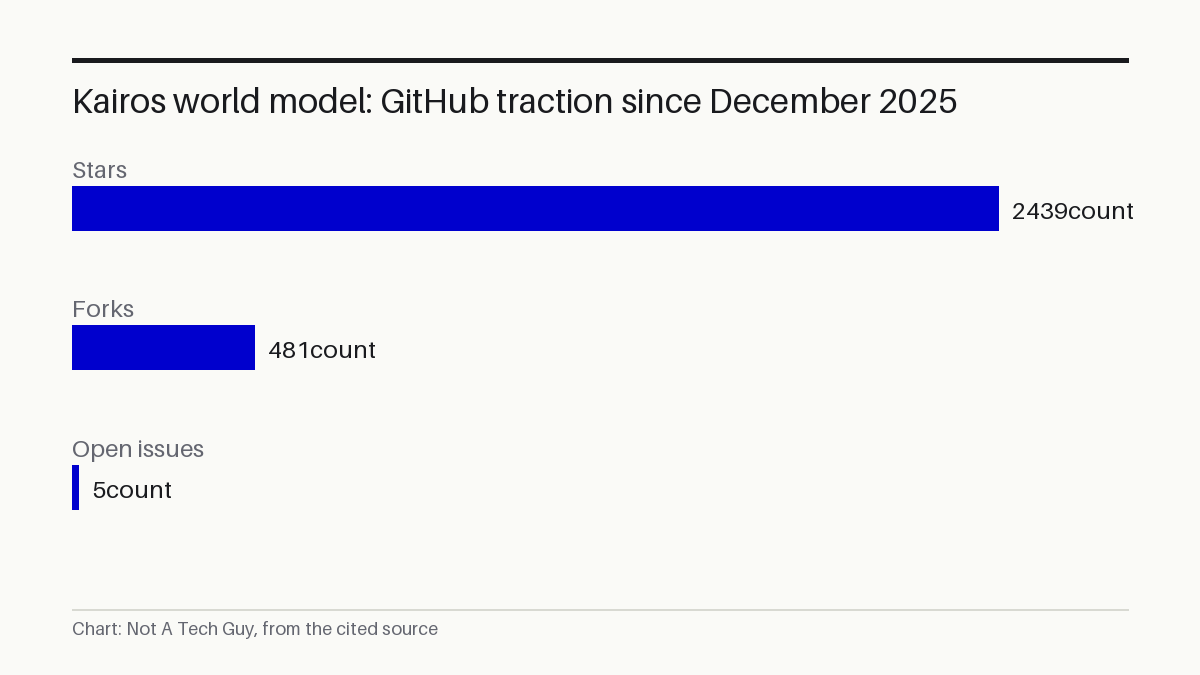
This is not a hypothetical concern for a distant future. Open-source world models are already accumulating attention. Kairos, a world model whose code is public on GitHub, has 2,439 stars and 481 forks since its repository was created in December 2025 P³. The code is moving fast, and the security thinking is trying to catch up.
What to do about it
The paper organizes its defensive recommendations into six buckets: tracing the origin of data and models, hardening state estimates against corruption, requiring the model to express when it lacks confidence, vetting planned actions before they execute, scrutinizing the reward signals the model learns from, and applying runtime checks during live operation S¹.
For a team building an embodied AI system, say an agricultural robotics startup whose drones spray crops based on terrain predictions, the practical takeaway is to treat the world model as untrusted middleware. Don't let a single predicted trajectory authorise an action without an independent check. If the world model says "safe to fly forward," something outside the model should have veto power: a hard-coded geofence, a redundant sensor, a human in the loop for novel terrain.
This week, if you're working with a world model in production, audit one thing: does your system have any path where the world model's prediction alone can trigger a physical action with no external constraint? That path is the one this paper says to close first.
What we don't know yet
The paper is a preprint, not peer-reviewed, and all claims derive from this single source S¹. The taxonomy is theoretical. The authors propose evaluation protocols for safety failures but do not report empirical validation of their proposed defenses in real-world deployments S¹. The "predictive safety illusion" concept is a framework, not a demonstrated attack with measured outcomes.
The arXiv listing also carries a q-fin.GN (quantitative finance) category tag, which appears incongruous with the paper's topic and has no explanation in the available evidence S¹.
The next signal: whether any group demonstrates a predictive safety illusion attack against a deployed world model, and whether peer review accepts or rejects this taxonomy. We'll watch for empirical follow-up papers and conference submissions through late 2026, and check the claims against them.
If you want reporting like this, the kind that reads the paper so you get the finding instead of the abstract, subscribe.
Sources: S1 — Security of World-Model-Based Embodied AI: A Lifecycle of Threats, Def · P2 — Security of World-Model-Based Embodied AI: A Lifecycle of Threats, Def · P3 — kairos-agi/kairos · P4 — Security of World-Model-Based Embodied AI: A Lifecycle of Threats, Def · P5 — Evaluate & Evaluation on the Hub: Better Best Practices for Data and M
More from Not A Tech Guy
- OpenAI 'abundant intelligence' post lays out AI cost flywheel
- MTGuard paper targets malicious MCP tool use in AI agents
- RSMeM: satellite AI agents learn from mistakes, 6% accuracy gain
Generated from an audited evidence pack with primary-source research. Social-media items are discussion signals, not verified facts. Nothing here is financial, legal or medical advice.