

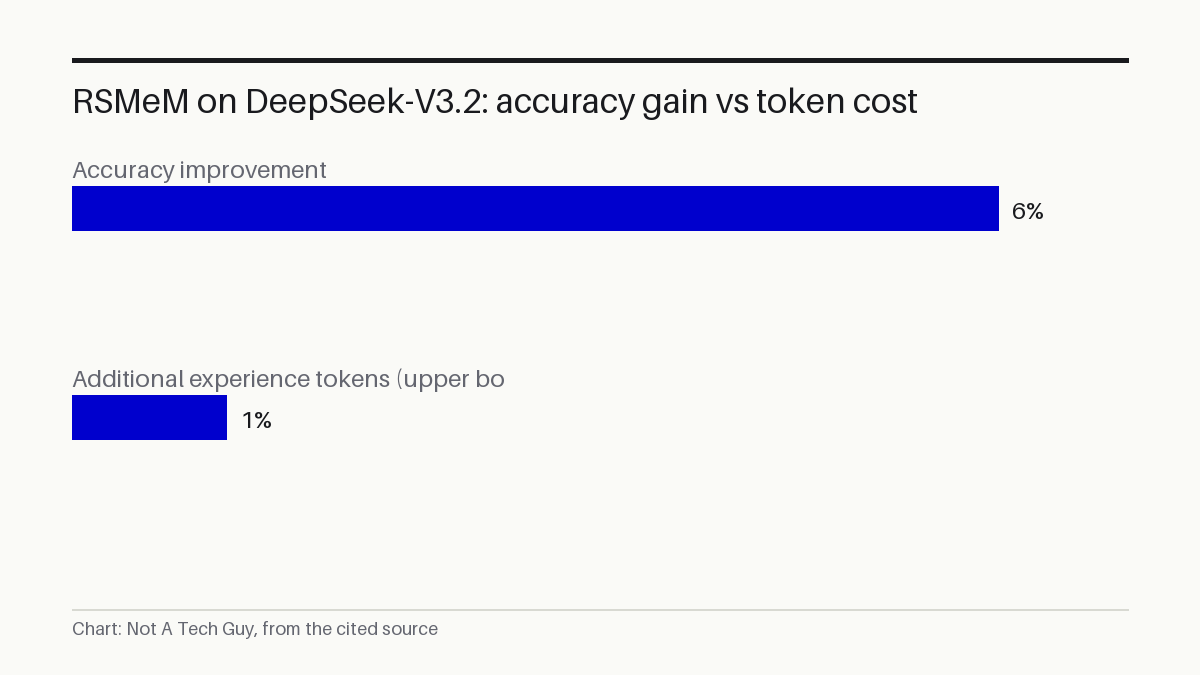
RSMeM, a new memory system for remote sensing AI agents, lifts DeepSeek-V3.2's accuracy by 6% while adding less than 1% extra tokens to the prompt, according to an arXiv preprint published this week S¹. The mechanism is deceptively simple: it teaches agents to remember their own mistakes and turn them into rules for next time. If that holds up, it changes the economics of running specialised AI agents on satellite imagery, where every wrong tool call burns compute and time.
My read: This is the first agent memory paper I've seen that frames the problem as cost rather than capability. The 6% gain on DeepSeek-V3.2 is modest, but the less-than-1% token overhead is the real headline. Most memory-augmented agent systems balloon the context window, which kills inference economics. If RSMeM genuinely compresses failure lessons into tight constraints, the approach could travel well beyond remote sensing. I don't buy the "brittle and error-prone" framing of existing agents as a universal claim yet, because the authors have an obvious incentive to overstate the problem they're solving. The single-source, unpeer-reviewed status also means the 6% number needs independent verification before anyone builds on it.
Why satellite AI agents keep making the same mistakes
Remote sensing analysis is not a single-shot question. An agent might need to identify a region, select the right tool, run it, interpret the output, then chain to the next step. General-purpose LLMs handle each step in isolation. They don't know which tools work for which terrain types, and they don't remember that a particular retrieval method failed on cloudy imagery last time S¹.
The authors of RSMeM, a team from the Chinese Academy of Sciences' Institute of Geographic Sciences and Tsinghua University P², say that when agents fail, those failures rarely get captured in a form the next run can use S¹. Every run starts from scratch. Every error gets repeated.
Two parts that do different jobs
RSMeM has two components, and they solve different halves of the problem S¹.
Hierarchical Knowledge Grounding works before the agent acts. It retrieves relevant domain knowledge from a structured, hierarchical corpus organised by taxonomy. When the agent needs to plan which tool to call, it pulls the right slice of domain context rather than relying on whatever the base model absorbed during training. Think of it as a curated reference shelf the agent consults before each decision S¹.
Failure-Aware Experience Refinement works after the agent fails. It takes the trace of a failed tool call, annotates what went wrong, and distills that into a reusable constraint for the next round. The agent retries with a rule that says don't do that again, and here's why S¹.
The combination matters because it addresses both sides of the agent reliability problem: better inputs through grounding, and better feedback loops through failure refinement. Most existing agent frameworks handle one or the other.
The 6% number and what it costs
The headline result: RSMeM boosts both tool-selection accuracy and final answer correctness on the EarthBench benchmark, and it does so across several different LLM backbones, not just one S¹. The specific figure cited is a 6% accuracy improvement on DeepSeek-V3.2, achieved with less than 1% additional experience tokens S¹.
That token cost figure is the part worth paying attention to. Memory systems for AI agents typically work by stuffing more context into the prompt, which drives up inference cost (inference being the cost of actually running the model). If RSMeM delivers gains at under 1% token overhead, the approach is cheap to run and effective beyond a lab setting.
The broader context: OpenEarthAgent, a separate framework for tool-augmented geospatial agents presented at ECCV 2026 P⁴, shows the field is moving fast. Multiple research groups are building agent systems specifically for Earth science workflows, and memory is becoming the differentiator.
What to do about it
If you run a team that uses LLM-based agents for geospatial analysis, whether that's crop monitoring, disaster response, or urban planning, the practical question is whether your agents learn from their own errors today. Most don't.
Consider a small environmental consultancy that runs daily satellite imagery checks for a state agriculture department. Their agent might call a vegetation index tool, get a wrong result on a partially cloud-covered scene, and then make the same call tomorrow on similar imagery. RSMeM's failure-aware approach would capture that failure, tag it, and feed back a constraint: for cloud-covered scenes, use the cloud-mask tool first. The next run skips the dead end.
The code is reportedly available at github.com/AI9Stars/RSMeM S¹, though we have not verified the repository is accessible or complete. If you want to test the concept this week, the cheapest experiment is simpler than adopting RSMeM wholesale: log your agent's failed tool calls for a week, manually write constraints from the patterns you see, and add them to the system prompt. That's a crude version of what RSMeM automates, and it'll tell you whether your workflows have the failure-repetition problem the paper describes.
What we don't know yet
Everything in this story comes from a single arXiv preprint S¹. The 6% accuracy figure is self-reported by the authors and has not been independently verified. The paper has not been peer-reviewed. The claim that existing remote sensing agents are brittle and error-prone is the authors' framing, not an independent assessment S¹.
We don't know whether the EarthBench benchmark is broad enough to generalise the results, or whether the less-than-1% token overhead holds at scale across different task types. We don't know whether the GitHub repository contains complete, working code, or whether the hierarchical knowledge corpus is practical to build for domains outside remote sensing.
The next signal: the RSMeM code repository at github.com/AI9Stars/RSMeM, if accessible, will let independent developers reproduce the EarthBench results. We'll check the repo and report back on whether the claims hold. If you want that follow-up, subscribe and we'll send it to you.
Sources: S1 — RSMeM: Knowledge-Enhanced Memory Evolution for Remote Sensing Agents w · P2 — RSMeM: Knowledge-Enhanced Memory Evolution for Remote Sensing Agents w · P3 — [2607.24772v1] RSMeM: Knowledge-Enhanced Memory Evolution for Remote S · P4 — mbzuai-oryx/OpenEarthAgent · P5 — alopatenko/LLMEvaluation
More from Not A Tech Guy
- Change2Task turns pull requests into coding agent tasks at 79.6%
- AI agent trust model cuts telecom cascade from hours to real-time
- TraceCoder adds audit trail to AI-generated code
Generated from an audited evidence pack with primary-source research. Social-media items are discussion signals, not verified facts. Nothing here is financial, legal or medical advice.


