

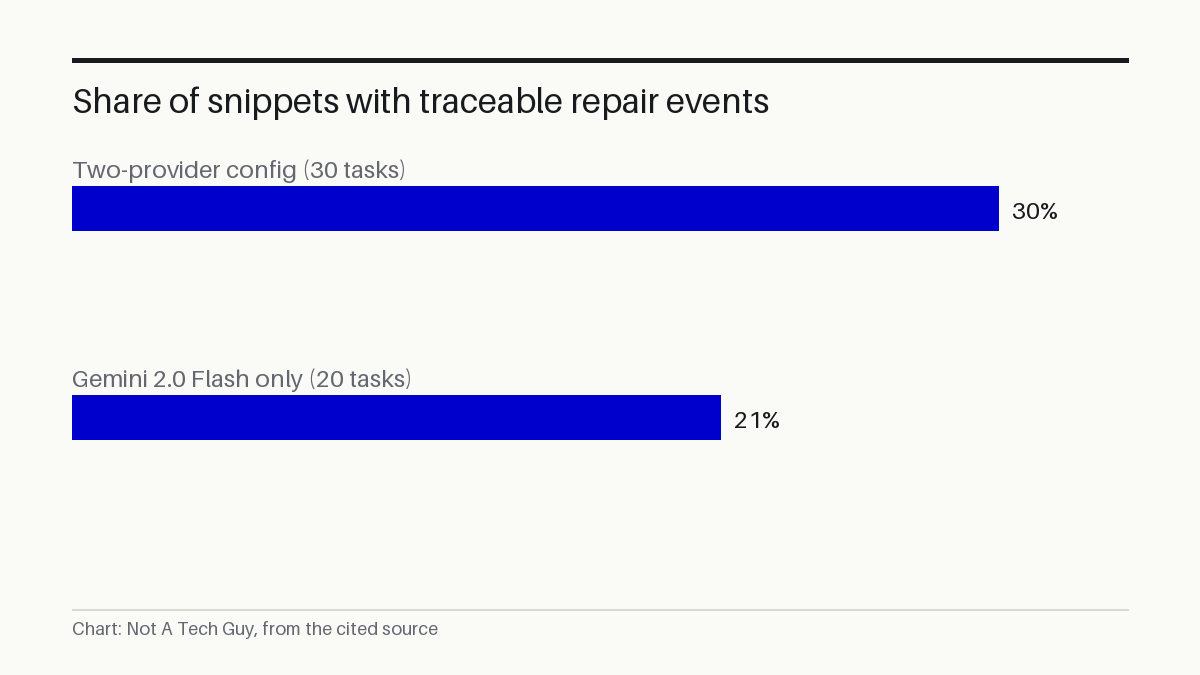
A new arXiv preprint called TraceCoder records every failed test, every repair attempt, and every model explanation behind each line of AI-generated code S¹. Three in ten snippets in its evaluation carry a traceable repair-event row, so a developer can hover over a line and see exactly which benchmark failure forced the model to rewrite it S¹. But the same evaluation shows 10 of 30 tasks burned through the entire six-iteration repair budget without converging, and the paper never claims the code came out better, only that its history became visible S¹.
My read: This is the first code-generation paper I've seen that treats the repair history as the product, not the final code. Most AI coding research chases pass rates on benchmarks. TraceCoder ignores that race and instead asks: can we reconstruct why a model arrived at a particular line? I'm skeptical of the 30% "Mean Chg%" figure because the abstract never defines it, and 30 algorithmic tasks is a thin bench. But the core idea, making AI code repairs replayable, fills a gap that matters more as AI-written code ships into production.
The invisible repair loop
When an LLM coding agent writes code, runs it against tests, fails, and rewrites, that repair loop is usually invisible. The model produces a final answer. The failed attempts vanish. The reasoning behind each line stays hidden, the code's evolution through test-driven repair disappears, and auditing after the fact can't be done S¹.
This matters more than it sounds. If you can't see how code evolved, you can't audit why a particular line exists.
How the system works
TraceCoder has three parts.
First, a fractional position-key indexing scheme assigns a stable identifier to each code snippet using tree-node delimiters. The identifiers are lexicographically ordered, so you can track a specific snippet across multiple repair rounds without disrupting the surrounding lines S¹.
Second, a relational schema logs four fields per repair event: which benchmark failed, which round it was, what the error message said, and what the model claims it fixed S¹. Each row is a checkpoint in the code's evolution.
Third, a browser-based visualisation tool renders this history as heat-mapped, hover-annotated source code S¹. You see the final program, and hovering over any highlighted line reveals the repair events that shaped it.
What 30 tasks actually revealed
The authors tested TraceCoder on 30 algorithmic programming tasks covering string processing, math computation and data-structure manipulation, across two provider configurations S¹.
Ten of those 30 tasks exhausted the six-iteration repair budget, all involving subtle edge-case behaviour S¹. The system didn't solve them. It just made the failures visible.
Three in ten code snippets carried a traceable repair-event row S¹. When the authors ran Gemini 2.0 Flash as the sole provider on a 20-task subset, that rate dropped to 21% S¹. The paper presents this as a comparison, though the exact framing is ambiguous in the source text.
The authors also report a "Mean Chg%" of 30%, but the abstract doesn't define what this metric measures, making it hard to interpret S¹. Three detailed case studies walk through specific examples, showing which benchmark failures shaped each line of the final program S¹.
Two papers, one name, no overlap
A different paper, also called TraceCoder, appeared on arXiv earlier this year (arXiv 2602.06875) from a team at Chongqing University of Posts and Telecommunications P²P⁴. That paper takes a different approach: a multi-agent framework for automated debugging of LLM-generated code. Same name, different mechanism, different authors. Neither paper cites the other, as far as the available evidence shows.
What to do about it
If you run a team that uses AI coding agents, the gap TraceCoder targets is real. Consider a small dev shop in Melbourne that uses LLM agents to generate boilerplate API handlers. When a generated endpoint fails in staging, the developer sees the broken code but not the three failed attempts that preceded it. If the model tried a regex that silently dropped edge cases, rewrote it twice, and landed on a version that passes tests but mishandles Unicode, nobody knows. TraceCoder's approach, recording each repair attempt with the failure text and model explanation, would let that developer replay the reasoning and catch the silent regression.
The practical step this week: check whether your AI coding workflow preserves intermediate attempts or discards them. If your tool drops failed generations, you have no audit trail. Start logging the model's outputs at each repair round, even as plain text files, so you can reconstruct the chain later.
What we don't know yet
The biggest unknown is whether visibility actually improves outcomes. The paper doesn't claim TraceCoder produces better code, higher pass rates, or fewer bugs than standard LLM agents. It claims the code's history becomes auditable and replayable S¹. That is a different proposition.
The evaluation covers 30 algorithmic tasks, not production codebases. Mean Chg% is undefined. The 21% comparison figure is grammatically ambiguous in the source. The visualisation tool and codebase don't appear to be publicly available. And the paper hasn't been peer-reviewed; it is a single arXiv preprint with no independent corroboration S¹.
The next signal: watch for a follow-up paper or code release from the authors that defines Mean Chg%, opens the visualisation tool, or tests the system on real-world repositories. If the approach holds up on production code, the audit-trail angle becomes a serious tool for compliance-heavy industries. We'll check any follow-up against these claims. If you want that follow-up in your inbox, subscribe and we'll send it when it lands.
Sources: S1 — TraceCoder: Explainable and Auditable Code Generation with Position-Ke · P2 — TraceCoder: A Trace-Driven Multi-Agent Framework for Automated Debuggi · P3 — VERINA: Benchmarking Verifiable Code Generation · P4 — Paper page - TraceCoder: A Trace-Driven Multi-Agent Framework for Auto · P5 — sijieaaa/CodeBoost
More from Not A Tech Guy
- AI search lifts e-commerce discovery to 80% at 30% cost
- 23 AI agents tested on breach response: zero passed
- Reinforced Dreamer fixes flaw in AI world model training
Generated from an audited evidence pack with primary-source research. Social-media items are discussion signals, not verified facts. Nothing here is financial, legal or medical advice.


