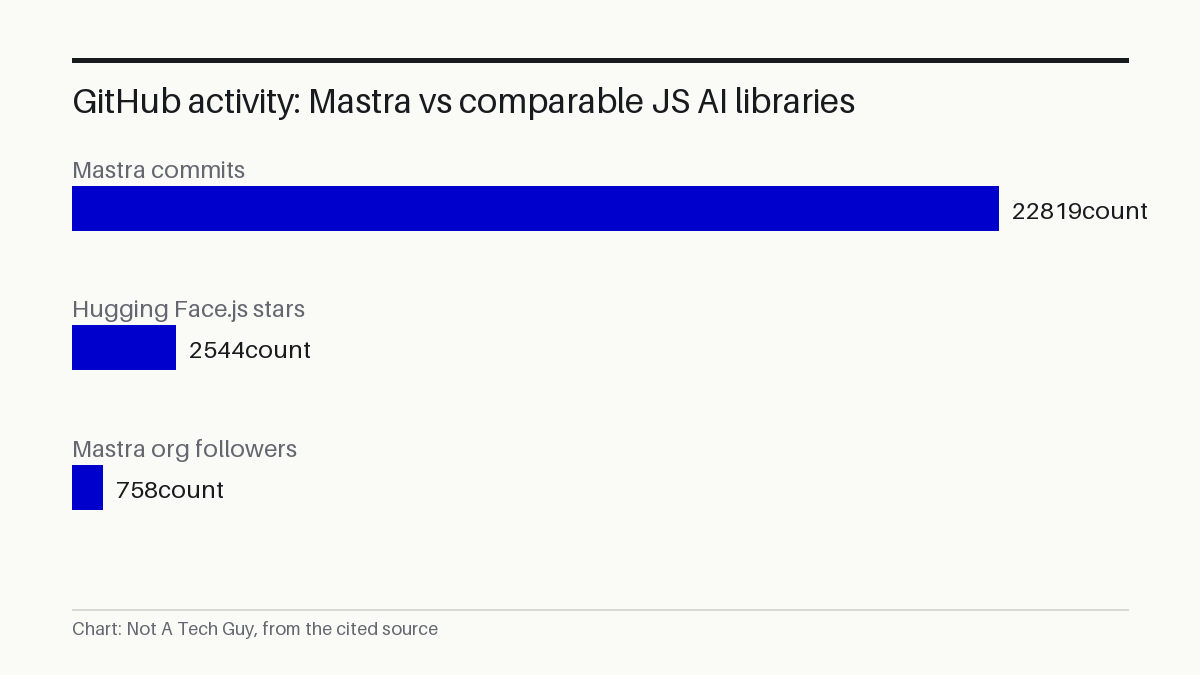

The mastra-ai organisation landed its TypeScript AI framework on GitHub's daily trending list on 18 November, backed by 22,819 commits across the repository S¹P². Every feature claim comes from the maintainers' own README, with no independent review or third-party benchmark published yet.
The 40-provider routing claim is the one to test first: It is a README assertion, not a verified benchmark, and a single interface across 40+ providers is the kind of promise that holds until a provider exposes a non-standard parameter. The open-issues count on the repo matters more than the star count, because trending status is an ephemeral algorithmic signal that says nothing about production readiness. Building a critical path on this framework without running a single agent against two providers and checking whether the output format actually matches would be premature.
Mastra's toolkit spans agents, workflows, and MCP servers
The framework, created by a United States-based organisation in October 2023 with 139 public repositories and 758 followers P³, positions itself as a comprehensive toolkit for AI-powered applications. The README lists self-directed agents that combine LLMs with external tools to handle open-ended tasks, a workflow engine built on graphs for sequencing multi-step operations, and pause-and-resume controls that hold an agent or workflow until a human signs off on the next step S¹ — though this human-in-the-loop behaviour is described only in the README, with no released code to inspect for how suspension state is persisted or how timeouts are handled. It also supports building Model Context Protocol servers, the emerging standard for exposing tools and structured resources to AI models, and ships with built-in evaluation and observability features S¹.
Model routing is the central pitch: the maintainers say the framework connects to 40+ providers through a single interface S¹ — a vendor's own figure from the README, not independently verified. The framework integrates with React, Next.js, and Node.js applications, or deploys as standalone endpoints S¹. The README states that a single command, npm create mastra@latest, scaffolds a new project S¹.
For a backend TypeScript developer building agent pipelines, the 40-provider routing abstraction would replace hand-written adapter code for each model API, but the absence of verified cross-provider output consistency means each integration still needs its own schema validation pass.
No benchmarks, no latency data, no third-party comparison
None of these capabilities has been independently tested or verified by a third party. The evidence pack contains no benchmark results, no latency measurements, and no comparison against alternatives like the Hugging Face JavaScript library, which carries 2,544 stars and an MIT licence P⁴. The 22,819 commits suggest active development P² — a GitHub metric with no code quality assessment attached, but commit count says nothing about API stability or whether the 40-provider routing actually works as advertised across every provider.
The human-in-the-loop feature matters more than it looks. When AI email agents comply with 45% of adaptive phishing attacks, the ability to suspend an agent before it acts on a suspicious input is not a nice-to-have. Mastra's claim that it can pause a workflow and await human approval before resuming S¹ addresses exactly that failure mode, but the README does not describe how the suspension state is persisted, what happens if the user never responds, or how timeouts are handled.
The MCP server authoring support is a signal of where the ecosystem is heading. Medusa's commerce platform built for AI agents and OpenAI's training of agents on Ironclad contracts both point toward a world where agents need standardised ways to discover and call external tools. Mastra's MCP support positions it for that trajectory, though the implementation depth is impossible to judge from the README alone.
Routing abstraction is the first failure point
A TypeScript developer evaluating Mastra should run npm create mastra@latest S¹, wire a single agent to two different providers from the 40+ list, and verify that the output schema matches across both. If the routing abstraction leaks, you will see it in the first hour. If it holds, the next checkpoint is whether the built-in observability captures tool-call failures as well as successful runs.
The repository showed 22,819 commits as of 18 November S¹P².
Sources: S1 — mastra-ai/mastra: Mastra is the modern TypeScript framework for AI-pow · P2 — GitHub - mastra-ai/mastra: Mastra is the modern TypeScript framework f · P3 — Mastra · P4 — huggingface/huggingface.js · P5 — allenai/awesome-open-source-lms
Written from 5 sourced items, 4 of them primary.