

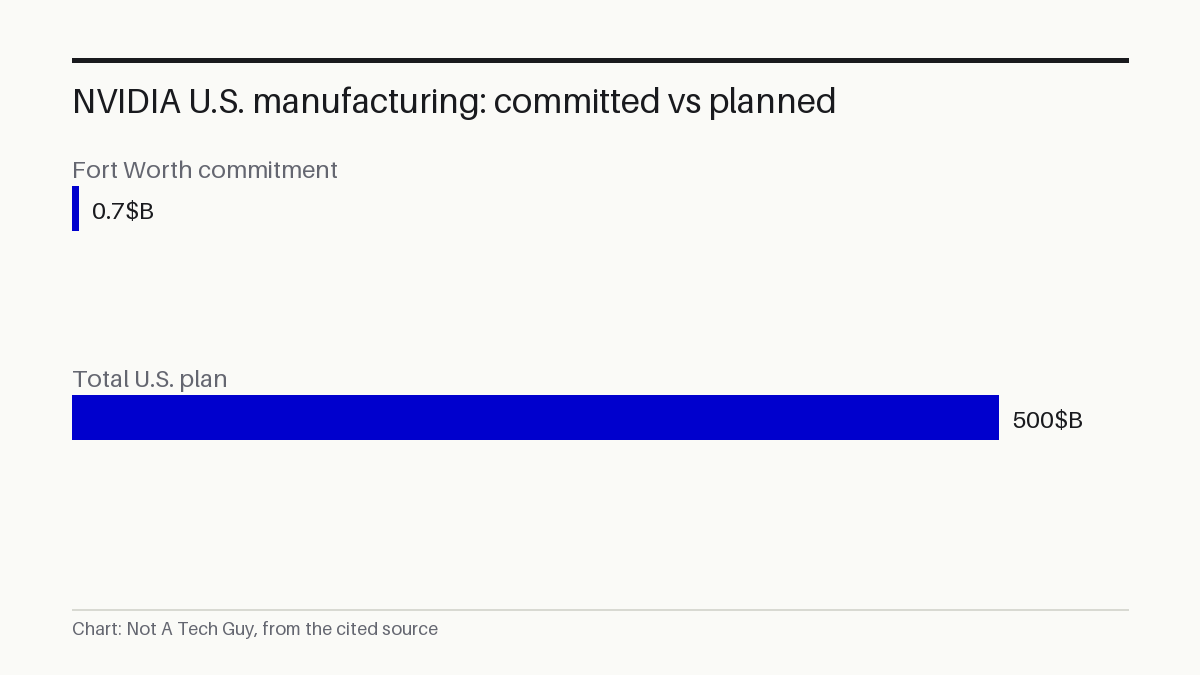
Wistron, an NVIDIA partner, has launched a 324,000-square-foot factory in Fort Worth, Texas. The site is currently manufacturing the GB300 Grace Blackwell Ultra Superchip, a processor powering leading AI platforms S¹. This plant is part of a $700 million investment in domestic advanced manufacturing. NVIDIA's broader initiative with collaborators like TSMC, Foxconn, Corning, and Amkor totals up to $500 billion. The difference between these figures highlights the contrast between current operations and future promises.
My read: This represents the most tangible progress in NVIDIA's push to manufacture in the United States. The Fort Worth facility is an operational factory producing the current top-tier chip, rather than a conceptual rendering or mere future promises. However, the $500 billion figure should not be viewed as fully committed capital. It represents a multi-year goal that might include partner expenditures outside NVIDIA's direct control. The $700 million associated with Fort Worth is concrete and verifiable. Keep an eye on employment figures: 500 currently, with a target of 1,000 by the end of the year. If Wistron achieves this, the domestic manufacturing narrative has strong potential.
What the Fort Worth line is building right now
The factory is currently producing the GB300 Grace Blackwell Ultra Superchip S¹. This is NVIDIA's premier processor, utilized in AI systems for training and executing large language models. Jensen Huang and Wistron Chairman Simon Lin jointly appeared at the inauguration, where Huang emphasized that manufacturing is a fundamental pillar for any nation and economy S¹.
The site is also getting ready to manufacture the NVIDIA Vera Rubin Superchip S¹. Vera Rubin is NVIDIA's upcoming processor designed to reduce the cost efficiency of intelligence for AI agents. Preparing a domestic facility for this chip indicates that the upcoming generation of NVIDIA hardware could be produced in the United States from the outset.
The map beyond Texas
Fort Worth represents a single point within a broader network. NVIDIA and its collaborators have brought advanced semiconductor production back to the U.S. to assemble and evaluate Blackwell chips in Arizona, with active manufacturing at TSMC's Phoenix site S¹. Additional AI supercomputer factories are slated for Houston with Foxconn and another Wistron site in Dallas S¹. NVIDIA's domestic ecosystem of partners and suppliers extends across 43 states, encompassing semiconductors, boards, systems, and racks S¹.
The investment in Fort Worth stands at $700 million. The comprehensive domestic strategy, involving partners like TSMC, Foxconn, Wistron, Corning, Lumentum, Coherent, and Amkor, targets up to $500 billion in AI infrastructure S¹. Both numbers originate from NVIDIA's perspective, with the $500 billion representing a prospective strategy rather than spent capital.
What to do about it
For enterprises utilizing NVIDIA hardware for AI workloads, the key consideration is whether domestically produced chips will be delivered faster, at a lower cost, or with greater reliability than imports. Currently, the Fort Worth facility manufactures the GB300, but NVIDIA has not released any pricing or lead-time variations for American-made units compared to those from international sites. This supply chain transition is most significant for organizations that must schedule capacity months in advance.
Take, for example, an Austin-based AI consultancy developing bespoke models for the healthcare sector. Presently, it secures GPU capacity via cloud providers and waits in the same queues as others. Should domestic manufacturing streamline the journey from silicon to server rack, the primary bottleneck would shift from chip availability to data center power and cooling infrastructure. While this presents a new challenge, it is simpler to manage due to its local nature. The consultancy could negotiate energy agreements with Texas utility companies, seek state-level incentives, and construct a roadmap independent of trans-Pacific shipping timelines.
A task for this week: review NVIDIA's Made in USA webpage at nvidia.com/en-us/made-in-usa/, which details partner locations by state P⁴. When planning AI infrastructure budgets, verify the production locations of specific chips, as the Fort Worth facility and the proposed Dallas site are separate operations with distinct manufacturing focuses.
What we don't know yet
The $500 billion target is a strategic plan, not an executed purchase order. NVIDIA has not revealed a schedule for this expenditure, the breakdown between NVIDIA's direct capital and partner commitments, or its reliance on government incentives. Current evidence indicates no confirmed U.S. government funding or subsidies are included in these investments.
The 1,000-employee objective for Fort Worth is a year-end target, not the present workforce. The facility currently employs over 500 people S¹. Wistron's ability to double its headcount will hinge on hiring conditions in the Dallas-Fort Worth labor market, which is highly competitive for advanced manufacturing talent.
Assertions regarding partner facility production, such as TSMC's Phoenix location, originate from NVIDIA's blog rather than independent confirmations from the operators themselves S¹. The Arizona Blackwell testing line, along with the Houston and Dallas supercomputer factories, are characterized as operational or in planning, yet NVIDIA has not disclosed specific launch dates or production capacities for any of these sites.
The next milestone: NVIDIA's Q3 FY2027 earnings report, anticipated in November 2026, is expected to detail capital expenditures and any segment-specific data regarding domestic manufacturing. We will evaluate the $500 billion claim against this report. To follow this development, subscribe, and we will continue to monitor this story.
Sources: S1 — NVIDIA and Partners Build in America, for America · P2 — Built in Fort Worth: Wistron Opens Advanced Manufacturing Plant to Pro · P3 — pipeworx-io/mcp-data-fortworth · P4 — US AI Manufacturing | NVIDIA · P5 — yan-labs/jensen-huang-nvidia-catalyst
More from Not A Tech Guy
- PEARL 4B model beats DeepSeek 685B at optimization modeling
- DBMol designs drug molecules using AI structure prediction
- AI safety paper: the quiet failures nobody measures
Generated from an audited evidence pack with primary-source research. Social-media items are discussion signals, not verified facts. Nothing here is financial, legal or medical advice.