Jensen Huang trained a robot from a laptop on the GTC Berlin stage. The NVIDIA founder and CEO showed AI agents running on an RTX Spark machine guiding Hugging Face's Microduck robot through NVIDIA Isaac Lab, using the Hermes Agent framework and Nemotron 3.5 Bolt 74B S¹. The demo landed five days after RTX Spark's October 16 release S¹, as NVIDIA pushed its full local AI hardware lineup to European developers at the conference running October 20 to 22 S¹P⁴.
My read: This is the first time I've seen NVIDIA frame a consumer laptop as a robot-training platform. The GTC Berlin demo is the use case that makes those specs legible. I'm skeptical of the 1-petaflop and 1440p 100fps claims because they come from NVIDIA's own blog with no independent benchmarks cited. The Underdog agent's on-device promise is the part I'd watch: if a third party verifies that inference stays local, that changes the calculus for privacy-sensitive workflows.
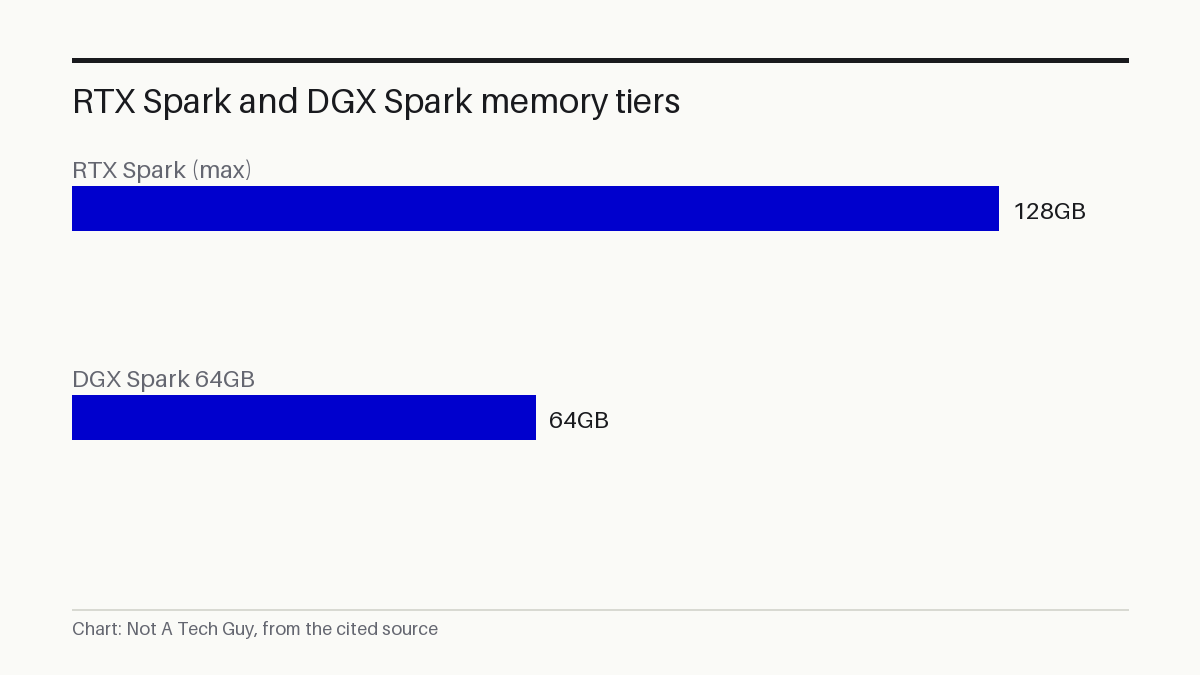
RTX Spark ships with up to 128GB of unified memory and 1 petaflop of AI compute — vendor-reported figures with no released code, no error bars, and no outside testing S¹. The machines target personal agents on Windows. Laptops from ASUS, Dell, HP, Lenovo, Microsoft and MSI are available now, with Acer listed as coming soon S¹.
DGX Spark adds a 64GB configuration for clustered inference
DGX Spark, the Linux counterpart for developers, gets a 64GB variant rolling out from partners on October 23 S¹.
A single 64GB unit supports models such as Nemotron 3.5 Bolt 74B 24GB, Qwen3.8 27B and Gemma 4 26B-A4B S¹. Linking several units through ConnectX-7 networking and the NVIDIA Sync Cluster Assistant lets a group of up to eight DGX Sparks tackle larger coding models, among them Qwen 3.8 Flash Next, DeepSeek v4 Flash 0731 and GLM 5.3 Flash S¹. That eight-unit clustering requires manual configuration S¹.
NVIDIA Sync adds a Model Launcher tool this month S¹. The October DGX Spark software update also brings a Wi-Fi Assistant and refreshes the DGX Spark Skills package S¹.
Underdog Desktop Agent keeps inference on the machine
The Underdog Desktop Agent, now available for download on RTX Spark, runs models entirely on device using its Husky model-specific inference engine S¹. That on-device claim comes from NVIDIA's blog, and no third party has confirmed whether any data leaves the machine during operation S¹. For a developer at a financial firm building a document-analysis agent, the difference between a model that runs locally and one that calls a cloud endpoint is the difference between a deployable tool and a compliance problem.
DGX Station, the enterprise Linux machine, gained seven new manageability integrations and three open-source reference workflows for robotics S¹.
NVIDIA Cloud Functions reaches DGX Station in early access, not general release S¹. A Windows version of DGX Station arrives in December, targeting manufacturing applications and agent frameworks S¹.
NVIDIA expanded its software stack with Recursive Flint, a new local coding model, alongside day-0 support for new releases from Nemotron, GLM, DeepSeek, Qwen, MiniMax and FLUX.3 S¹. The update also speeds up the llama.cpp and vLLM inference engines, which are the most popular open-source options for running models on local hardware S¹. NVIDIA bundled a set of checkpoints optimized for the hardware as part of the release S¹.
The next checkpoint is October 23, when DGX Spark 64GB systems begin shipping from partners S¹.
Sources: S1 — Bringing the Spark to Europe: Local Intelligence Powers Next Wave of A · P2 — nvidianews.nvidia.com · P3 — Paper page - Intelligence per Watt: Measuring Intelligence Efficiency · P4 — NVIDIA GTC Berlin: Live Updates on What’s Next in AI | NVIDIA Blog · P5 — NVIDIA/NeMo-Agent-Toolkit
Written from 5 sourced items, 5 of them primary.