

The Reserve Bank of Australia raised the official cash rate to 4.85% this week, its fifth increase of 2026 and the highest level since 2008 P²P³. It lands on a housing market already under pressure: Cotality, the property research group, reports that national dwelling values have dropped for seven consecutive months at the sharpest pace in roughly four decades S¹ (Cotality's underlying data and methodology have not been independently checked).
Where the savings actually live: The figure worth tracking is not the cash rate itself but the spread between what existing borrowers pay and what lenders offer new customers. RBA research from 2020 found that older variable-rate loans tend to carry higher interest rates than newly originated ones, even among borrowers with comparable risk profiles P⁶. That spread is what determines whether refinancing pays off. With Westpac projecting a 10.9% national price decline by March 2027 S¹ (a vendor forecast with no published error margins or model code), the real danger is that falling values push a borrower's loan-to-value ratio above 80%, triggering mortgage insurance that can cost thousands S¹. Buyers who purchased in the last 12 to 18 months with a deposit of 20% or less are the most exposed.
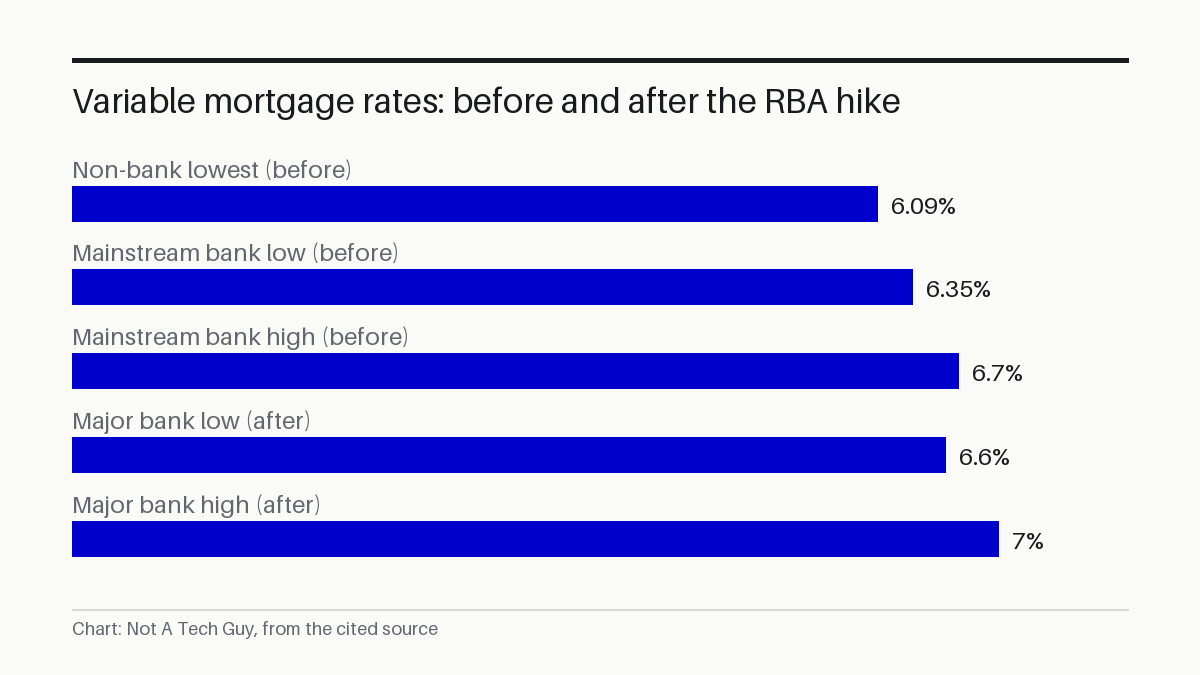
Variable rates climb within days of the RBA decision
A 25-basis-point increase typically flows through to variable mortgages within days, as most lenders pass it on in full S¹ (full pass-through is assumed, not yet confirmed by individual institutions). Before this week, the lowest advertised variable rate from a non-bank lender was 6.09%, while major banks listed rates between 6.35% and 6.7% S¹. With full pass-through, a standard variable loan from a major bank would sit near 6.6% to 7.0% S¹.
On a $500,000 loan over 30 years, the difference between 6.35% and 7.0% is about $220 a month — the gap between the best mainstream advertised rate before the hike and the expected major-bank rate after it, based on arithmetic on current market numbers.
Three numbers decide whether switching pays off
Lenders promote their lowest rates to attract new customers, which is the basic reason refinancing works as a strategy S¹. ASIC Senior Executive Leader Laura Higgins has previously urged borrowers to treat switching as a negotiation rather than a routine step P⁴. The advertised rate is only the starting point; three checks determine whether the move genuinely saves money.
Compare the right loan type. A headline rate that excludes an offset account or redraw facility is lower for a reason. If those features matter, search specifically for loans that include them and compare like with like S¹.
Check your exit costs. A current lender may apply discharge fees, early repayment penalties, or other closing charges that reduce the benefit of switching S¹. The federal government's free Moneysmart mortgage calculator allows you to enter both rates and fees to see whether the switch actually pays S¹.
Know your LVR. Lenders evaluate refinancing based on loan-to-value ratio — what you owe as a share of the property's current worth, not its purchase price S¹. Exceed 80% of the current value and mortgage insurance may apply, potentially running into the thousands S¹. Typing your address into realestate.com.au or Domain gives a rough price estimate. These tools are not precise, but they draw on measures similar to what banks use, such as recent local sales S¹.
For a mortgage broker working through this week's pipeline, the change means client files with equity near the 80% LVR line move from a routine repricing call to a harder conversation about whether a new lender will accept the loan S¹.
Recent buyers with thin deposits sit closest to the edge
Most people who bought even a few years ago remain ahead on property values relative to their purchase price S¹. A 15% downturn from current levels would only return prices to where they stood in early 2024 S¹.
The pressure concentrates on recent buyers. Those who purchased in the last 12 to 18 months, especially with a deposit of 20% or less, face the highest likelihood that falling values have pushed their equity below the 80% LVR threshold S¹. Lower property values can make it harder to refinance with a new lender or reprice with the existing one S¹.
ABS data from late 2022 showed owner-occupier refinancing between lenders reaching a record $13.4 billion in a single month, a 9.1% jump P⁵.
The RBA's next scheduled board meeting will indicate whether 4.85% holds or a further increase follows.
Sources: S1 — Thinking about refinancing your mortgage? Check these 3 things before · P2 — Statement by the Monetary Policy Board: Monetary Policy Decision | Med · P3 — Statement by the Monetary Policy Board: Monetary Policy Decision | Med · P4 — Switching home loans? ASIC tips for refinancing | ASIC · P5 — Refinancing reached another record high in November | Australian Burea · P6 — Box C: Do Borrowers with Older Mortgages Pay Higher Interest Rates? | · P7 — Quarterly authorised deposit-taking institution property exposure stat
Written from 7 sourced items, 6 of them primary.