
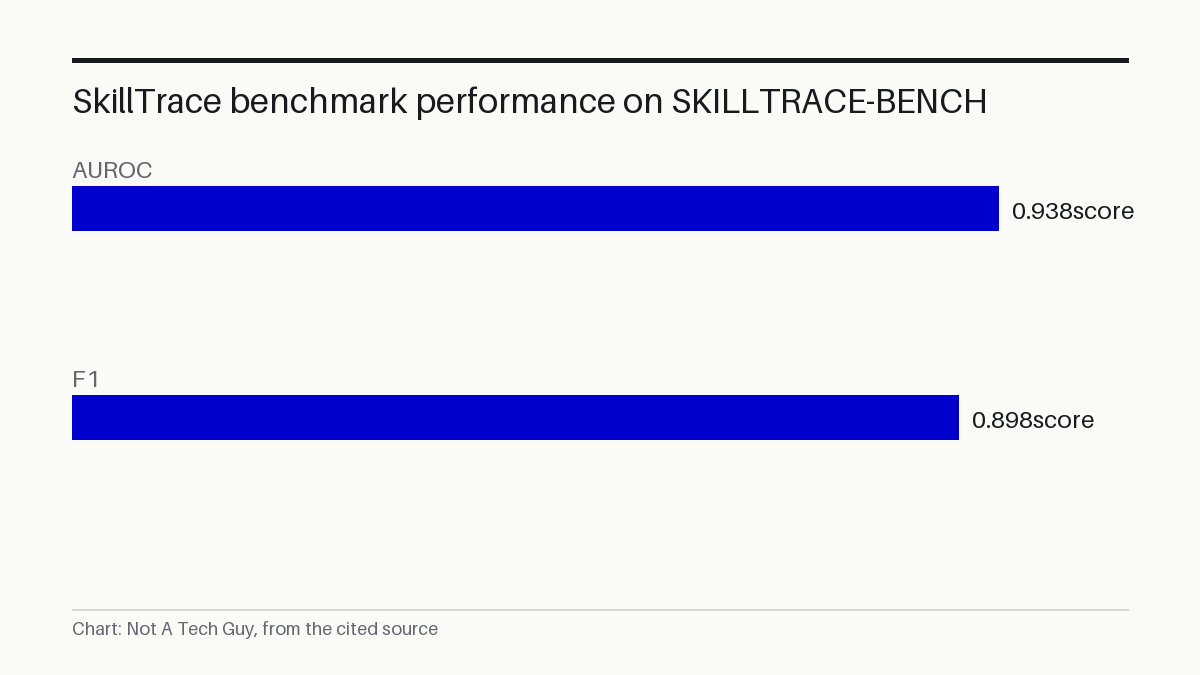
According to an arXiv paper published on 7 August (submission 2608.05204), SkillTrace evaluates how LLM-agent skills are reused by pulling out three distinct provenance signals and matching them without relying on an LLM during the process, achieving an AUROC of 0.938 on a benchmark created by the researchers S¹. The problem it addresses: current code clone detection tools evaluate entire source files or packages, causing them to overlook reuse where only a single component of a skill is retained. What occurs when a repository contains 36,446 skills and no one can identify which are secretly derived from existing ones?
My read: The most notable architectural decision is that the LLM is involved only a single time, during the initial ingestion phase, to assist in deriving the Operational trace. All subsequent steps rely on deterministic matching. This is significant because the auditing phase becomes both inexpensive and repeatable, avoiding the variability of additional LLM calls. I am skeptical of the 0.938 AUROC figure because SKILLTRACE-BENCH was constructed by the same team, and methods often look better when tested on benchmarks designed by their own creators. The scan of 36,446 skills in the wild is a more reliable indicator, but those findings are early and lack external validation. This is a preprint, not a peer-reviewed paper.
Why partial reuse breaks existing detectors
A skill for an LLM agent combines metadata, a natural language description, and executable code P². The code represents just one aspect. When a skill is reused, an individual might duplicate the prompt text while rewriting the code. Alternatively, they could retain the code but alter the description. They might also keep the operational flow, how the skill triggers and which resources it uses, while replacing the underlying implementation.
Current detection tools focus on single-modality source code or compare entire packages S¹. They successfully identify complete copy-paste jobs. However, they fail to detect partial reuse, where only a single component of the skill remains after the transfer.
Three traces, one deterministic comparison
The system pulls three distinct provenance signals from every skill S¹:
- Expression trace: the metadata and natural language layer, describing the skill's intended function.
- Implementation trace: the executable logic and source code.
- Operational trace: represented as a Skill Operational Graph (SOG) that maps out the activation, procedure, and resource-flow structure, detailing how the skill operates in practice.
An LLM is used solely for extracting the Operational trace, and this happens only a single time during the initial skill ingestion S¹. Later, during the audit phase, SkillTrace matches the stored traces using deterministic methods. The system adjusts each trace using strict negatives that perform the same function but were developed independently, and it indicates which trace backs up a reuse finding S¹.
This architecture is intentional: the costly, probabilistic LLM operation occurs once and is stored. The subsequent audit phase is both inexpensive and repeatable.
The benchmark and the wild audit
Using SKILLTRACE-BENCH, which contains 820 transformed reuse positives derived from 100 marketplace anchors alongside 751 negative controls, the system achieves an AUROC of 0.938 and an F1 score of 0.898 S¹.
The more challenging evaluation is the wild audit: 36,446 skills were examined for signs of reuse that repository-level baselines would overlook S¹. The researchers state that evidence attributed to the traces generates actionable queues for reviewing reuse. The language is precise: they are "review queues," not verified infractions. The tool identifies potential candidates, leaving the final decision to humans.
What to do about it
If you manage a team developing LLM-agent workflows, the issue of skill reuse is more immediate than it appears. Imagine a logistics firm where an internal agent platform allows analysts to share reusable skills. One group creates a skill that queries a shipping database and formats the output as a table. Another group copies it, replaces the database connector, retains the formatting logic, and publishes it under a different name. Six months later, no one realizes the two skills share a common origin. When the original skill develops a bug in its formatting logic, only a portion of the fleet receives the patch.
SkillTrace's three-trace method would detect this because the Operational trace, the Skill Operational Graph, would still align on procedure and resource-flow even if the implementation was altered. The Expression trace might differ if the description was modified, but the Implementation and Operational traces would highlight the shared lineage.
The actionable step this week: if your team oversees a library of agent skills, select five pairs you suspect are related and see if your current code clone tool identifies the connection. If it overlooks pairs where only the prompt text or only the operational flow is shared, that is the gap SkillTrace aims to address.
What we don't know yet
This document is an arXiv preprint S¹. It has not undergone peer review, and the concerns are legitimate: the benchmark is self-constructed, the wild audit findings are early, and the "marketplace anchors" in SKILLTRACE-BENCH represent the authors' perspective and might not correspond to any actual commercial platform. It is unknown how the system handles skills written in languages or frameworks outside its training data, or how well the Operational trace extraction works when the LLM used for the one-time ingestion is less capable or smaller.
Public GitHub repositories on this subject are limited. The code associated with the paper does not seem to have a public, populated repository yet. A related initiative, zjunlp/SkillX, which automatically builds skill knowledge bases for agents, has 265 stars and was created in January 2026 P⁵. Two other repositories, luojingkun22/acquabench P³ and hideya/skilltrace P⁴, both have zero stars and seem to be early-stage or unrelated personal projects.
The next signal: acceptance into a peer-reviewed venue such as NeurIPS, ICLR, or ICSE, which would include reviewer feedback and ideally an independent benchmark evaluation. We'll check this claim against it. If this kind of breakdown is useful, subscribe to keep reading the next one.
Sources: S1 — SkillTrace: Multi-Trace Provenance Auditing for LLM-Agent Skill Reuse · P2 — SkillTrace: Multi-Trace Provenance Auditing for LLM-Agent Skill Reuse · P3 — luojingkun22/acquabench · P4 — hideya/skilltrace · P5 — zjunlp/SkillX
More from Not A Tech Guy
- MedUPS lifts medical AI next-step accuracy 11 points
- RAG study tests LLaMA, Mistral and Qwen to cut AI hallucinations
- Chained RLM architecture restarts LLM reasoning with fresh context
Generated from an audited evidence pack with primary-source research. Social-media items are discussion signals, not verified facts. Nothing here is financial, legal or medical advice.