
Home Assistant, the open-source home automation platform, appeared on GitHub's daily trending list this week with 90,295 total stars S¹. That is an unusual spot for a project old enough to have a release history stretching back years, not weeks. What is pulling a 90,000-star repository back into the spotlight now, and what does that tell us about where smart home computing is actually heading?
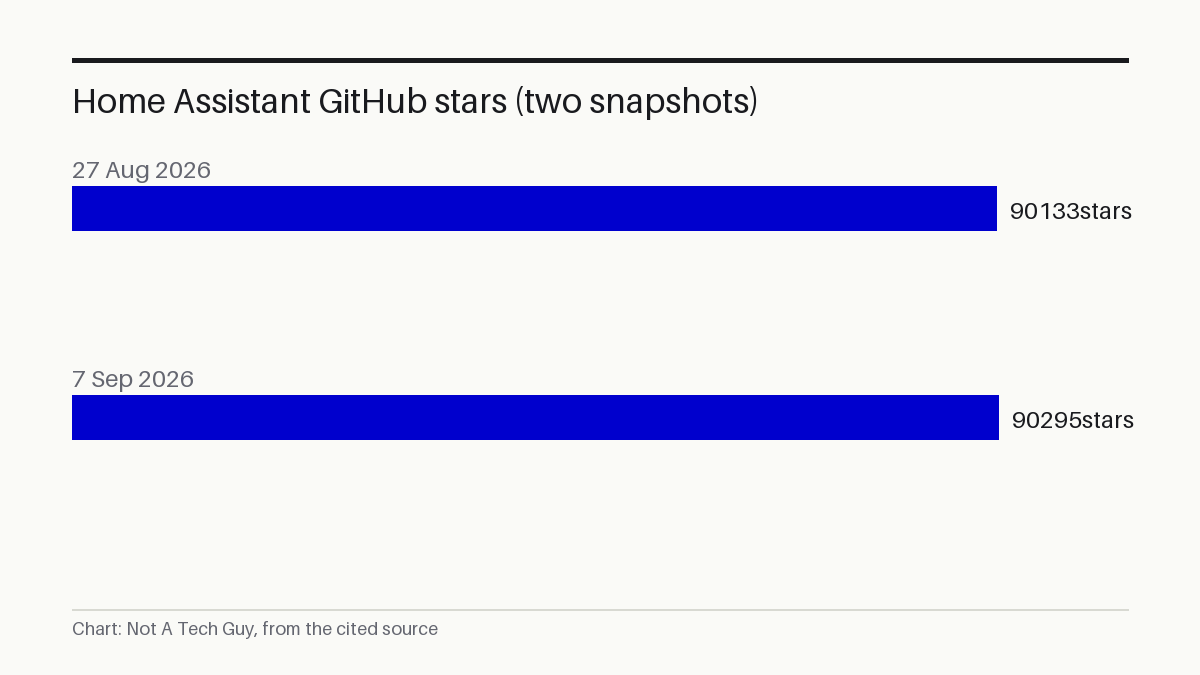
My read: This is the first time I have seen a mature, community-driven home automation project trend alongside fresh AI repos on GitHub's daily list. The star count is not exploding. Thirty-five in a day is modest for trending. But the steady climb from 90,133 to 90,295 over eleven days S¹S² tells me this is sustained interest, not a viral spike. I am skeptical of reading too much into a single trending snapshot, but the timing aligns with a broader shift I have been watching: people questioning whether their smart home data belongs in someone else's cloud.
Why a 90,000-star project is still trending
Home Assistant is not a newcomer. The repository, written primarily in Python S¹S², has been accumulating stars for years. A release tagged 2026.5.0 was published on 6 May P⁵, when the project already sat at roughly 89,000 stars. By 27 August, a GitHub Trending snapshot recorded 90,133 stars with 32 added that day S². Eleven days later, on 7 September, another snapshot showed 90,295 stars with 35 added that day S¹.
That is roughly 162 stars over eleven days. Not explosive. But for a project this size, consistent daily growth is what keeps it visible on GitHub's trending algorithm, which weighs recent activity alongside total stars.
The project's creators highlight that it is a free, locally hosted smart home system focused on keeping user data private S¹S². They recommend running it on affordable hardware like a Raspberry Pi or a personal server S¹S², noting its component-based design S¹S² and the global community of hobbyists who build and maintain it S¹S². A badge on the project page indicates it is an initiative of the Open Home Foundation S¹S².
The privacy bet that runs on a $50 computer
The pitch is simple. Instead of your lights and thermostat phoning home to Google or Apple servers, Home Assistant runs on hardware you own. A Raspberry Pi, a small single-board computer that costs about $50, is enough to run the whole system S¹S².
Every command stays on your network. No cloud round-trip. No account with a company that might change its terms or shut down a service.
This is the opposite architecture from the dominant smart home platforms. Google Nest, Amazon Alexa, and Apple HomeKit all route at least some processing through their cloud. Home Assistant inverts that: the intelligence lives in your house.
The project's OS release in June, version 18.0, updated the Linux kernel from 6.12 to 6.18 across all supported platforms and upgraded Docker to v29.5.3 P³. That is the kind of infrastructure work that keeps a community project runnable on cheap hardware years after launch.
The open-source trust question
Home Assistant is a counterpoint. It is genuinely open source, backed by the Open Home Foundation S¹S², and its value proposition, local control, is verifiable. If you install it on a Raspberry Pi and disconnect your internet, your automations still run. That is a test anyone can perform in five minutes.
The README links to home-assistant.io for a demo, installation instructions and documentation S¹S², which means the project maintains its own documentation site rather than relying on a wiki or scattered forum posts.
What to do about it
If you have a smart home with more than three or four devices, the cloud dependency problem is already real. A light bulb that needs a server in another country to turn on is a light bulb with a single point of failure.
Consider a small architecture firm that has automated its office lighting and climate control using a commercial cloud platform. If that platform raises its subscription price or experiences an outage, the firm's building stops being smart. Home Assistant running on a local server removes that dependency. The trade-off is setup time: the maintainers say the system is modular S¹S², which means you configure each integration yourself rather than getting a plug-and-play experience.
One practical thing you can do this week: go to home-assistant.io, try the demo the README links to S¹S², and check whether your existing smart devices are supported. The compatibility list is public, so you can verify before installing anything.
What we don't know yet
The evidence does not tell us why Home Assistant trended on these specific days. The daily star gains, 32 and 35, are modest, and no specific release, security patch, or news event has been linked to the trending appearance. The two snapshots show slightly different numbers, which is expected given they were taken on different days, but neither should be treated as the definitive current figure.
All product descriptions, privacy claims, and architecture claims come from the maintainers' own README, not from an independent review. The privacy and local-control features have not been independently audited or verified by a third party.
There is no Australian market data or local server presence in the evidence. The story is global open-source technology news.
The next signal: Home Assistant's next monthly release, following the 2026.5.0 pattern P⁵, should arrive in early October. We will check whether the star growth accelerates or settles, and whether the release notes mention any privacy or local-AI features that might explain the renewed attention.
Sources: S1 — home-assistant/core: 🏡 Open source home automation that puts local con · S2 — home-assistant/core: 🏡 Open source home automation that puts local con · P3 — Home Assistant OS 18.0 · P4 — modzy/hugging-face-raspberry-pi · P5 — 2026.5.0 · P6 — huggingface/open-r1
More from Not A Tech Guy
- Banning personal AI at work barely cuts risk, study finds
- Hugging Face datasets trends on GitHub as AI data prep scales
- OpenWhispr: free voice dictation app hits GitHub trending
Generated from an audited evidence pack with primary-source research. Social-media items are discussion signals, not verified facts. Nothing here is financial, legal or medical advice.