PyTorch appeared on GitHub's daily trending list on 27 August 2026 with 102,613 total stars, gaining 22 new ones that day S¹. The repository was created on 13 August 2016 P³, making it ten years old the same month it trended. What keeps a decade-old framework on a list built for new momentum?
My read: The +22 daily stars are modest, not a surge. But a ten-year-old framework showing up alongside week-old repos on a trending list tells me the foundation layer of AI still draws developer attention. The README's claims about GPU acceleration and dynamic networks are the maintainers' own description P², not an independent benchmark. I'd treat the capability language as project documentation, not verified performance.
What the project claims to do
According to its README, PyTorch is a Python package built around two main capabilities: running tensor math on GPUs, and constructing deep neural networks that use a tape-based automatic differentiation engine P². Tensors are multi-dimensional arrays, like a spreadsheet extended into three or more dimensions. Autograd is the engine that automatically calculates how to adjust a model's parameters during training.
The README enumerates six modules: torch (the core library), torch.autograd (gradient computation), torch.jit (compilation for deployment), torch.nn (neural network building blocks), torch.multiprocessing (distributed training), and torch.utils (utilities including data loading) S¹.
The maintainers emphasize reverse-mode auto-differentiation, which they say allows modifying network behavior during execution with no perceptible delay or cost S¹. In practice, that means a researcher can alter the structure of a neural network mid-training without recompiling the whole system. That flexibility matters for experimental AI research, where model architectures change from one experiment to the next.
Why a ten-year-old framework still trends
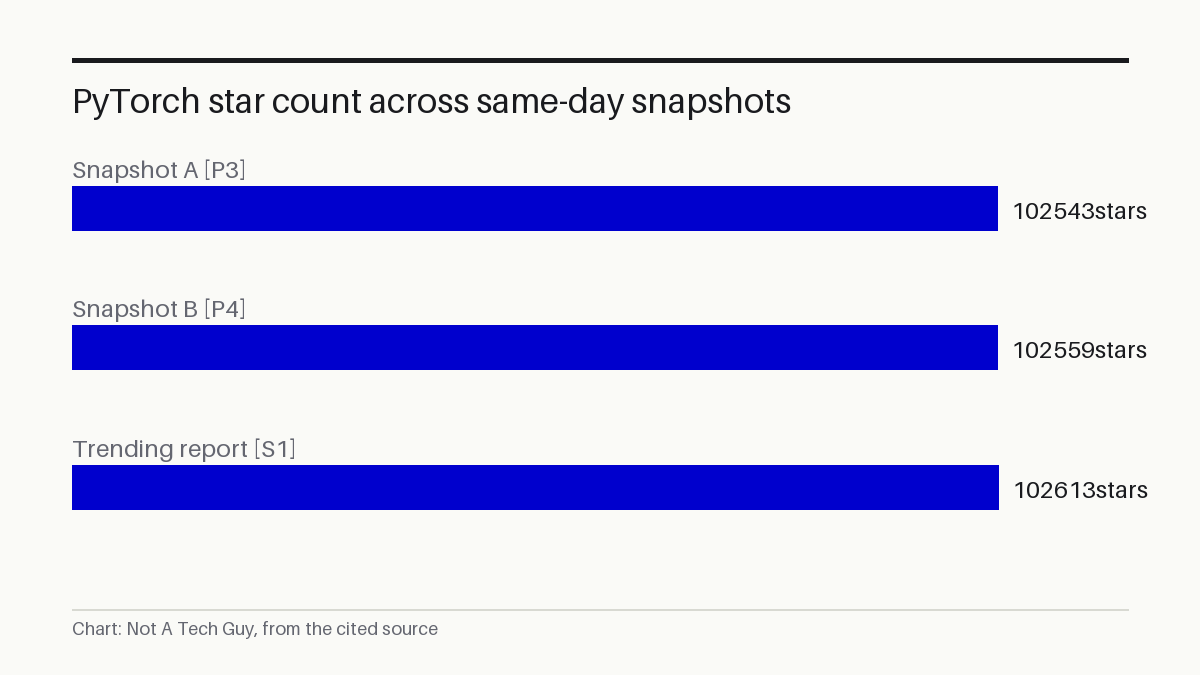
The star count tells a story of steady accumulation. Multiple snapshots from the same period show 102,543 stars P³, 102,559 P⁴, and 102,613 at the time of the trending report S¹. Those are same-day readings at different times, not a spike.
The codebase itself explains the staying power. The repository spans C, C++, CUDA, Python, Assembly, and HIP (a GPU compute layer), among other languages P³. PyTorch is a Python interface wrapped around high-performance C++ and GPU kernels. Researchers write in Python. The speed comes from the layers underneath.
What to do about it
The trending appearance is a nudge, not a reason to change frameworks. The practical impact depends on what you're building.
Consider a computational biology team training models on protein sequences. Protein chains vary in length, which means the neural network's input shape changes with every sample. PyTorch's dynamic graphs handle that naturally because the computation graph is rebuilt for each input. A team already working in PyTorch would see no reason to move. A team evaluating frameworks for variable-length data should test PyTorch's autograd against their specific workload before committing.
For anyone hiring AI engineers, the star count is a rough proxy for talent pool size. More stars means more developers who know the framework, which means a wider hiring pipeline. PyTorch's 102,000-plus stars suggest that pool is deep.
One thing to check this week: search GitHub for the last five AI research papers you found interesting and note which framework their code releases use. The pattern will tell you what your field has settled on.
What we don't know yet
We don't know why PyTorch trended on this specific day. The +22 stars could reflect a conference mention, a tutorial, a new release, or simply GitHub's algorithm surfacing an older repository. The evidence pack notes the README is the maintainers' own description, not an independent review S¹, so the GPU acceleration and dynamic network claims remain self-reported.
The star count varies slightly across sources (102,543 P³, 102,559 P⁴, 102,613 S¹), which is expected for real-time metrics but means any single number is a momentary reading.
The next signal: watch PyTorch's release page on GitHub for the next version drop. If a new release coincided with the trending appearance, that would explain the timing. We'll check the claim against it. Subscribe and we'll send the follow-up when it lands.
Sources: S1 — pytorch/pytorch: Tensors and Dynamic neural networks in Python with st · P2 — README.md · P3 — pytorch/pytorch · P4 — pytorch/pytorch · P5 — MokshithRao/ai-research-assistant
More from Not A Tech Guy
- DeepMind's double-blind AI test locks benchmarks in crypto box
- AI coding agent defense cuts malware severity 83%
- WebMCP-Phalanx blocks 80 of 80 prompt injection attacks in browser agents
Generated from an audited evidence pack with primary-source research. Social-media items are discussion signals, not verified facts. Nothing here is financial, legal or medical advice.