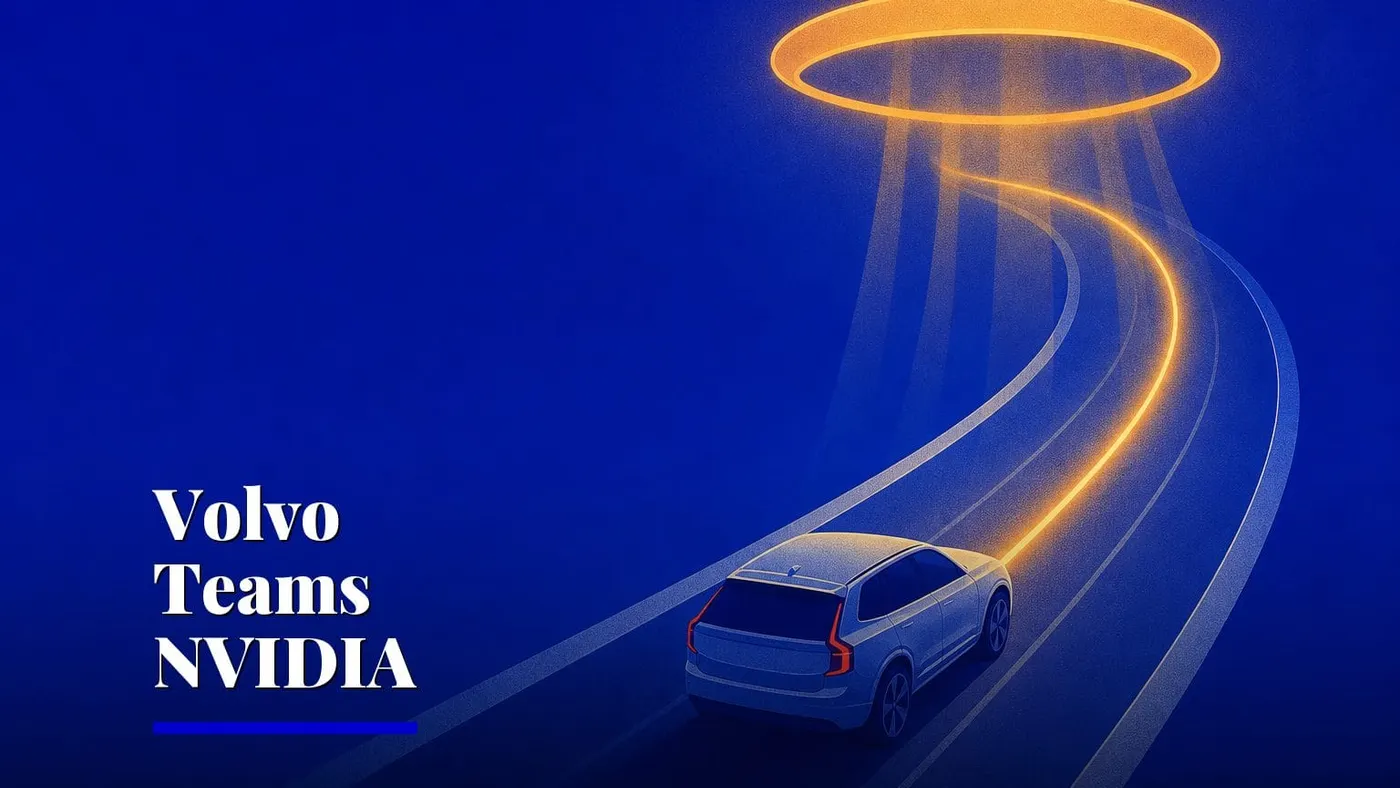
Volvo Cars and NVIDIA announced on 15 October 2026 that they are deepening a partnership that began in 2017, aiming to bring door-to-door automated driving to future Volvo electric cars S¹. The companies promise "eyes-off and mind-off driving" but have disclosed no launch date, no SAE autonomy level certification, and no financial terms S¹.
My read: This is the third NVIDIA mobility story in six weeks, and the pattern is clear: NVIDIA is locking down automotive compute platforms the way it locked down data centre GPUs. What I find interesting is that Volvo is explicitly tying its brand, built on nearly a century of crash-safety research S¹, to NVIDIA's silicon rather than developing its own stack. That is a big bet. The "eyes-off and mind-off" language is aspirational, not certified, and I would watch whether any regulator signs off on it before a production car ships.
What is actually in the deal
The expanded partnership centres on three NVIDIA technologies: the Hyperion sensor and compute architecture, Halos OS, and Alpamayo Stack driving software S¹. Volvo will combine these with its own vehicle safety systems and engineering work S¹. NVIDIA's own blog describes Hyperion as a platform bundling sensors, high-performance compute and software for software-defined vehicles P⁴.
Jensen Huang, NVIDIA's founder and CEO, said the partnership combines Volvo's safety systems with Hyperion and Halos to build cars that make driving "safer and more effortless" S¹. Håkan Samuelsson, Volvo's president and CEO, framed it as merging two strengths: Volvo's safety knowledge and NVIDIA's AI technology S¹.
The technology will debut in a next-generation Volvo car, part of what the company calls its largest-ever product push S¹. No model name, no year, no market rollout sequence has been disclosed.
What is ambition and what is delivered
Several claims in the announcement are forward-looking. The "gradual introduction of eyes-off and mind-off driving" is a corporate aspiration, not a certified or shipped feature S¹. The description of Volvo as a "leader in software-defined cars" and the claim of "the industry's most advanced computing capabilities" are promotional language from the press release, not independently verified assessments S¹. No third-party outlet has separately corroborated the technical capabilities beyond republishing the announcement.
The companies describe their collaboration as "decade-long" while also stating it began in 2017 S¹. The GitHub organisation for Volvo Cars, created in September 2017, confirms the engineering relationship traces to that year P³.
NVIDIA has been pushing hard into automotive compute. As we found when NVIDIA said its robotaxi tech runs every major fleet, the company positions its DRIVE platform as the industry standard for autonomous driving. The Volvo deal extends that strategy beyond robotaxi fleets and into consumer passenger cars. NVIDIA's broader compute ambitions, including the AI factory capacity it targets in Australia, show how central automotive AI has become to the company's revenue mix. The same compute philosophy is reaching consumer devices too, scaled down to 1-petaflop AI on Windows laptops with RTX Spark.
For an automotive engineer evaluating platforms, the relevant question is whether Hyperion's sensor fusion and compute pipeline can handle the edge cases Volvo's safety team has spent decades cataloguing. The press release publishes no benchmark data, no error rates, no disengagement statistics. The NVIDIA blog on Hyperion describes the architecture in general terms but provides no independent validation P⁴.
The next concrete checkpoint is the debut of the next-generation Volvo car, which the company has not dated.
Sources: S1 — Volvo Cars and NVIDIA Expand Partnership to Advance Safe Automated Dri · S2 — Volvo Cars and NVIDIA Expand Partnership to Advance Safe Automated Dri · P3 — Volvo Cars · P4 — NVIDIA Opens Up DRIVE Hyperion 8 AV Platform | NVIDIA Blog · P5 — Hugging Face and NVIDIA to Accelerate Open-Source AI Robotics Research
Related reading
- NVIDIA targets 2 GW of AI factory capacity in Australia by 2027 — our technology desk, 2026-09-10
- NVIDIA RTX Spark brings 1-petaflop AI to Windows laptops — our technology desk, 2026-10-07
- NVIDIA says its robotaxi tech runs every major fleet — our technology desk, 2026-09-10
Written from 5 sourced items, 4 of them primary.